From LatinTutorial
Basic English Grammar for Students of Latin Part I (3:31)
Thursday, February 15, 2018

Wednesday, February 14, 2018
Quizlet Game/Quiz on Film Pompeii Last Day
Go to Quizlet using this link: Pompeii Last Day For Quizlet Live Game
Teacher should choose Quizlet Live button to start the game.
Choose How to Play the game, choosing the first of the two choices: "Definition plus Term"
This will generate a game code for students. When all students have logged in with their full name the game can start. This game can be played several times.
Teacher should record which student groups completed the game first.
Valete,
Magistra Gill
Teacher should choose Quizlet Live button to start the game.
Choose How to Play the game, choosing the first of the two choices: "Definition plus Term"
This will generate a game code for students. When all students have logged in with their full name the game can start. This game can be played several times.
Teacher should record which student groups completed the game first.
Valete,
Magistra Gill
Hebdomas quarta: Quizizz success!
Salvete, discupuli!
You did well on the quiz. Keep up the good work and take good notes. What you learn now will help you when we begin the textbook.
Optime!
Magistra Gill
You did well on the quiz. Keep up the good work and take good notes. What you learn now will help you when we begin the textbook.
Optime!
Magistra Gill
Hebdomas Quarta - Probatio in Quizizz UPDATED
ACCESS CODES FOR QUIZIZZ PROBATIO ON DOCUMENTARY FILMS
654949 (EXPIRED)
Link to Quizizz
318418 (CURRENT FOR UNTIL 2/23)
654949 (EXPIRED)
Link to Quizizz
318418 (CURRENT FOR UNTIL 2/23)
Hebdomas QuINTA--Scavenger Hunt with Textbook Ecce Romani I. TASK 3 FOR 2/20
In the pages section of the blog is a list of questions that lead you through a scavenger hunt designed to familiarize you with your textbook.
Saveneger Hunt
Saveneger Hunt
Hebdomas quarta - Explore Art and Architecture of Rome, Pompeii and Herculaneum through Images
February 14, 2018 - Felix dies Valentini
Ut vales? How are you doing?
optima! (great)
bene (well, fine)
non male (not badly)
male (not well, badly)
pessime (horribly)
I gather you all are in various places in the class and homework assignments. So I am giving a list here of activities of varying lengths for you and your teacher to choose from. They can be done independently with a computer or iPad.
Khan A Beginners Guide to Ancient Rome
Khan Roman Wall Painting in Pompeii
Khan Hellenistic Art sculpture, mosaic, painting - mostly Roman, who were often copying Greek art
A lecture by Diana Kleiner of Yale on Herculaneum, Roman domestic architecture, painting
Video accompanying an exhibition on Pompeii in California in 2014
Photo Gallery of Images from Pompeii in Creative Commons (Browse these images and choose 3 to download and show to class or upload to Google Drive. What can you learn about the image? Why did you choose it?)
Take Notes in your interactive note book.
Ut vales? How are you doing?
optima! (great)
bene (well, fine)
non male (not badly)
male (not well, badly)
pessime (horribly)
I gather you all are in various places in the class and homework assignments. So I am giving a list here of activities of varying lengths for you and your teacher to choose from. They can be done independently with a computer or iPad.
Khan A Beginners Guide to Ancient Rome
Khan Roman Wall Painting in Pompeii
Khan Hellenistic Art sculpture, mosaic, painting - mostly Roman, who were often copying Greek art
A lecture by Diana Kleiner of Yale on Herculaneum, Roman domestic architecture, painting
Video accompanying an exhibition on Pompeii in California in 2014
Photo Gallery of Images from Pompeii in Creative Commons (Browse these images and choose 3 to download and show to class or upload to Google Drive. What can you learn about the image? Why did you choose it?)
Take Notes in your interactive note book.
Tuesday, February 13, 2018
Hebdomas quarta - Probatio (test/quiz) on documentaries
February 13, 2018
Yesterday's quiz expired so I am providing a link to the same test with a new time limit. The link and access will be good for the entire day.
Here is the code:966816
Here is the link:Link to Quizizz Documentaries February 13
Don't forget to use your full name when you sign in.
Ago gratias (Thanks)
Magistra Gill
Yesterday's quiz expired so I am providing a link to the same test with a new time limit. The link and access will be good for the entire day.
Here is the code:966816
Here is the link:Link to Quizizz Documentaries February 13
Don't forget to use your full name when you sign in.
Ago gratias (Thanks)
Magistra Gill
Monday, February 12, 2018
Hebdomas quarta:Homework
Monday and Tuesday: Watch and take notes on BBC Life and Death in Heculaneum (YouTube)
Sunday, February 11, 2018
Hebdomas quarta: Pompeii The Last Day (BBC Documentary)
After you finish the test, begin a new documentary "Pompeii: The Last Day." This documentary reconstructs the last day before the city of Pompeii was buried by the eruption of the volcano Vesuvius. At the time, Romans did not even have a word for Volcano. The word come from the name of Vulcan -- a god of fire and metal work who lived under the earth.
This documentary combines social history with the history of science. It is uses archeological and documentary sources and is reliable.
Pliny the Younger, whom you met in Roman Empire in the First Century, is one of our main written sources, together with observations recorded by his uncle Pliny the Elder, a natural historian -- historian of nature, half scientist half historian.
This film is about 60 minutes long and historically reliable:Film: Pompeii Last Day
This documentary combines social history with the history of science. It is uses archeological and documentary sources and is reliable.
Pliny the Younger, whom you met in Roman Empire in the First Century, is one of our main written sources, together with observations recorded by his uncle Pliny the Elder, a natural historian -- historian of nature, half scientist half historian.
This film is about 60 minutes long and historically reliable:Film: Pompeii Last Day
Hebdomas Quarta: Test on Engineering Rome and Roman Empire in the First Century
Salvete, discipuli!
1) I have prepared a test/quiz (in Latin: probatio) on the films you have watched so far.
2) BEFORE you take the probatio. Please (quaeso) finish the timeline, following the same procedure as before: date on left, information on right, with any thoughts, questions or additional points.
3) Review your notes and viewing questions.
4) Take about 30 minutes to do the first two tasks.
5. Then go to the probatio. This is an online test. So use a computer or your phone. There are 40 questions -- all multiple choice.
You can take the test three times. To take the test again, you must log out then log in again.
Log on to Quizizz student: Quizizz student The code for this test is 115350.
Friday, February 9, 2018
Hebdomas tertia: Copy and Study PBS Timeline Rome in the First Century
Review for test on Monday by copying information from PBS timeline up through slide 26.
PBS Timeline
There will be a test on Monday on the two films: Engineering Empire and Rome in the First Century. Mostly multiple choice questions. Use your notes, the timeline and your answers to questions in the viewing guide to study. Both films are also available on YouTube. See links under header.
PBS Timeline
There will be a test on Monday on the two films: Engineering Empire and Rome in the First Century. Mostly multiple choice questions. Use your notes, the timeline and your answers to questions in the viewing guide to study. Both films are also available on YouTube. See links under header.
Hebdomas tertia: PRONUNCIATION OF VOWELS
LatinTutorial video on pronunciation of vowels in Latin.
Listen to this twice and practice mimicking the sounds. Make any notes that will help you remember the simple rules of pronunciation.
Listen to this twice and practice mimicking the sounds. Make any notes that will help you remember the simple rules of pronunciation.
Wednesday, February 7, 2018
Let's start talking. Consonant pronunciation and a dialogue
Salvete discipuli? Ut valete. Bene, spero.
Here is a link to to a two page text. One side has a dialogue between Victor and Philippus. I am including a recording of this dialogue here.
Watch and listen first to the short video that tells you how Latin consonants are pronounced: Consonants.
Then listen 3 times to the dialogue.
Here is a link to to a two page text. One side has a dialogue between Victor and Philippus. I am including a recording of this dialogue here.
Watch and listen first to the short video that tells you how Latin consonants are pronounced: Consonants.
Then listen 3 times to the dialogue.
Tuesday, February 6, 2018
February 6: Salvete discipuli!
Continue viewing Roman in the First Century and answering questions. I would suggest that you view the film on a laptop so you can pause the film when you need to.
https://www.youtube.com/playlist?list=PLHw57H6WrHt8hdgXjn6_0WKxevgfbwkpV
You may also work with a partner to complete the questions. Please be as thorough as you can in your answers.
In the event you finish all the questions you received yesterday, you can move on to Episode 4 and answer the questions for that Episode by following this link: Questions for Episode 4
https://drive.google.com/file/d/1hvFNM_WfEkwUanN6SdetnqgJfOdZZ7xg/view?usp=sharing
Thank you/ ago gratias, Magistra Gill
https://www.youtube.com/playlist?list=PLHw57H6WrHt8hdgXjn6_0WKxevgfbwkpV
You may also work with a partner to complete the questions. Please be as thorough as you can in your answers.
In the event you finish all the questions you received yesterday, you can move on to Episode 4 and answer the questions for that Episode by following this link: Questions for Episode 4
https://drive.google.com/file/d/1hvFNM_WfEkwUanN6SdetnqgJfOdZZ7xg/view?usp=sharing
Thank you/ ago gratias, Magistra Gill
Monday, February 5, 2018
February 4
Go to the online timeline for "The Roman Empire in the First Century." Begin with slide 11 and copy 11-15 into your interactive journal, putting dates on the lefthand side of the page and what is important about the date(s) on the righthand side.
Here is the link to the TIMELINE.
Go to the online timeline for "The Roman Empire in the First Century." Begin with slide 11 and copy 11-15 into your interactive journal, putting dates on the lefthand side of the page and what is important about the date(s) on the righthand side.
Here is the link to the TIMELINE.
Hebdomas tertia: Watching the PBS Documentary: Roman Empire in the First Century
Salvete, discipuli (hello students). Please say hello to your teacher (Salve, magister!)
The films you are watching provide useful information for reading
the stories in our textbook, Ecce Romani I. The stories form a
continuous narrative about a Roman family and things that happen to various
members of the household, including slaves. Topics that occur in the textbook
include:
•
Family life
•
Roman dress (for all classes and slaves)
•
Roman roads
•
Travel
•
Aqueducts
•
Domestic and public architecture
•
Slavery
•
Pompeii and the eruption of Mt. Vesuvius
•
The Flavian Amphitheater
•
The Cloaca Maximus
•
Chariot Races
•
Roman baths
•
Politics
•
Armies and army life
•
Roman gods and religious practices
The stories in our book begin in the year after the eruption of
the volcano Mt. Vesuvius (79 C.E.) which destroyed Pompeii and neighboring
towns in the vicinity of Naples, burying them under around 30 feet of ash and
volcanic rock. These towns stayed buried
until the 1700s, when they gradually began to be excavated. Eventually it became evident that the
volcanic covering had preserved almost as much as it had destroyed. This has
enabled archeologist and historians to learn an enormous amount about daily
life in the ancient Roman world and its material culture. Entire dining rooms
had been preserved complete with the food on the table. Our book relies on many of the discoveries
revealed by buried towns to create a plausible picture of one family’s daily
life. Find Pompeii on a map and mark it
on one of your blank maps of the Italian peninsula.
The textbook also expects that you are at least a little bit
familiar with the history of Rome and its leaders. So, what you learn from
“Rome: Engineering Empire” and “The Roman Empire in the First Century” will be
helpful as we work through the stories and cultural essays in the textbook.
Note: the sections that deal with English vocabulary that comes from English would work well as warm-ups. Do not hesitate to ask for the film to be paused if you think you missed something important to answering a question.
Thursday, February 1, 2018
The great conspiracy against Julius Caesar
Octavian/Augustus (the main subject of our next film) came to power as a consequence of the assassination of Julius Caear, his adoptive father.
Watch this five-minute video on the plot to kill Julius Caesar and then discuss in pairs the question posed by the film: what would you do if you were one of the senators who had to decide whether or not to murder Caesar? Share your answers.
Conspiracy against Julius Caesar
Watch this five-minute video on the plot to kill Julius Caesar and then discuss in pairs the question posed by the film: what would you do if you were one of the senators who had to decide whether or not to murder Caesar? Share your answers.
Conspiracy against Julius Caesar
PowerPoint Review of Engineering Empire
When you have finished Engineering Empire, review its content by watching the preview/review Power/Point by following this link: https://drive.google.com/file/d/1hy2R6gdpwEnLQkDp4x1i-lQw6K-xlI_4/view?usp=sharing
The teacher will show this to you and ask you to answer the questions it asks.
Time Line of Ancient Rome and Interactive Journal Instructions
Task 6
Print out the instructions for making an Interactive Journal. (https://drive.google.com/file/d/1qJIgynJbT2gu6LURAVLDXGUP8P5v4-wT/view?usp=sharing
The Interactive Journal Instructions are in the pages section of our blog. Go to the Interactive Journal Instructions Blog Page for printing, don't try to print from this post. Using a computer, go to the timeline for the next film we will watch, the Roman Empire in the First Century: Timeline
Take notes on the first 10 slides of the Timline, following the instructions below for creating an interactive journal. If you do not have a composition book yet, use a regular piece of looseleaf notebook paper.

Print out the instructions for making an Interactive Journal. (https://drive.google.com/file/d/1qJIgynJbT2gu6LURAVLDXGUP8P5v4-wT/view?usp=sharing
The Interactive Journal Instructions are in the pages section of our blog. Go to the Interactive Journal Instructions Blog Page for printing, don't try to print from this post. Using a computer, go to the timeline for the next film we will watch, the Roman Empire in the First Century: Timeline
Take notes on the first 10 slides of the Timline, following the instructions below for creating an interactive journal. If you do not have a composition book yet, use a regular piece of looseleaf notebook paper.

Maps of the Roman Empire - Resources
Task 5
Students use classroom computers to explore these resources and identify locations on set of blank maps. Note: you do not have to identify everything, since the upcoming films will help you. You can also google the names of places on the handout to find out where a place is.
World Atlas interactive map: World Atlas
Atlas of the World - Rome Wiki Commons (don't freak out - there are three introductions, one in Latin, one in Greek and then one in English)
Roman Empire Maps with Modern Country Names
List of Modern Country Names for Roman Empire
Clickable map of Roman Empire
Students use classroom computers to explore these resources and identify locations on set of blank maps. Note: you do not have to identify everything, since the upcoming films will help you. You can also google the names of places on the handout to find out where a place is.
World Atlas interactive map: World Atlas
Atlas of the World - Rome Wiki Commons (don't freak out - there are three introductions, one in Latin, one in Greek and then one in English)
Roman Empire Maps with Modern Country Names
List of Modern Country Names for Roman Empire
Clickable map of Roman Empire
Tuesday, January 30, 2018
Maps of Roman Empire Task Set 04
Here are a series of maps of the Roman Empire: before and after it was an empire. These are also included in class documents or pages section of the blog.
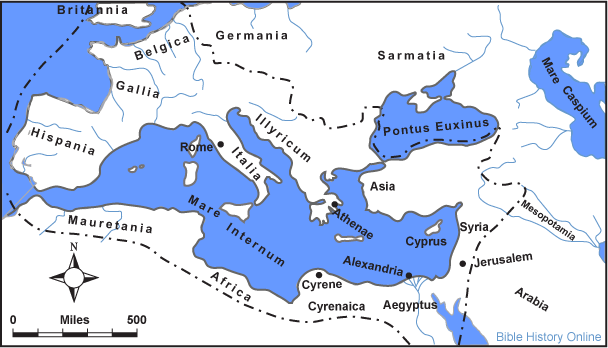
Here is a handout on Roman Geography with key sites listed and explained. You should print this out for your three-ring binder.Map of Roman territory at death of Julius Caesar 44 BCE

Here is a handout on Roman Geography with key sites listed and explained. You should print this out for your three-ring binder.Map of Roman territory at death of Julius Caesar 44 BCE
Monday, January 29, 2018
Hebdoma secunda - Task set 03
Preparation: photocopy or print crossword puzzle 02 on Engineering Empire.
Look at the following maps of Rome and its expansion:
Roman territory up to death of Julius Caesar
Here is a 10 minute video showing the expansion of Rome year by year. The history of ancient Rome is divided into three periods: The Monarchy, the Republic and the Empire. As you watch this video, keep your eye on the black smudge that is Rome at the beginning and then note the year and other information about who was ruling. Expansion of Rome
Before continuing with Engineering Empire, watch a series of short films by Khan Academy
Vespasian Flavian Amphitheater
Trajans Forum
Trajan's Column
Add information from these short films to your notes and/or viewing guide to Engineering Empire.
Do the second crossword puzzle (see pages under header) which covers Vespasian and Trajan.
Look at the following maps of Rome and its expansion:
Roman territory up to death of Julius Caesar
Here is a 10 minute video showing the expansion of Rome year by year. The history of ancient Rome is divided into three periods: The Monarchy, the Republic and the Empire. As you watch this video, keep your eye on the black smudge that is Rome at the beginning and then note the year and other information about who was ruling. Expansion of Rome
Before continuing with Engineering Empire, watch a series of short films by Khan Academy
Vespasian Flavian Amphitheater
Trajans Forum
Trajan's Column
Add information from these short films to your notes and/or viewing guide to Engineering Empire.
Do the second crossword puzzle (see pages under header) which covers Vespasian and Trajan.
Sunday, January 28, 2018
Hebdomas secunda: Nero - Vespasian - Trajan - Task Set Two
Task set two
Take the quiz on the Course Information Sheet. (5-8 minutes)
Review your Viewing Guide and identify questions you have not answered or not answered fully. See if you can fill in any more information. You can ask questions of other students in the class. (5-8 minutes)
Watch the next section of Rome: Engineering Empire on Nero. (approximately 15 minutes)
Your teacher will pause the film and give you a crossword puzzle that will check your knowledge of the first 40-50 minutes of the film. Take 10 minutes to do the crossword puzzle and then turn it in to the teacher.
Continue watching the film and filling out your viewing guide.
HOMEWORK: Using your viewing guide and what your remember from the film choose one of the engineering accomplishments that you think is especially important and write a good English paragraph or two (full sentences, correct spelling, includes emperor's names, etc.) explaining your choice and describing in detail why you think it was significant.
Don't forget that there is a link in the Day One post to the documentary on YouTube: https://youtu.be/C5obOUDyQ5s
Take the quiz on the Course Information Sheet. (5-8 minutes)
Review your Viewing Guide and identify questions you have not answered or not answered fully. See if you can fill in any more information. You can ask questions of other students in the class. (5-8 minutes)
Watch the next section of Rome: Engineering Empire on Nero. (approximately 15 minutes)
Your teacher will pause the film and give you a crossword puzzle that will check your knowledge of the first 40-50 minutes of the film. Take 10 minutes to do the crossword puzzle and then turn it in to the teacher.
Continue watching the film and filling out your viewing guide.
HOMEWORK: Using your viewing guide and what your remember from the film choose one of the engineering accomplishments that you think is especially important and write a good English paragraph or two (full sentences, correct spelling, includes emperor's names, etc.) explaining your choice and describing in detail why you think it was significant.
Don't forget that there is a link in the Day One post to the documentary on YouTube: https://youtu.be/C5obOUDyQ5s
Hebdomas secunda - Week Two - Task set One
Week Two beginning January 29- task set one
Salvete omnes! (hello everyone). Since it is hard for me to guess exactly how much material you will get through in a day, from here on out I am just going to post tasks, more or less in the order it makes sense to do them.
I am also going to offer some assignments that you may do independently using the classroom laptops and head sets.
I would like to call your attention to the collection of documents that I am adding to the site. You can see them listed right under the header.
Monday first tasks:
Salvete omnes! (hello everyone). Since it is hard for me to guess exactly how much material you will get through in a day, from here on out I am just going to post tasks, more or less in the order it makes sense to do them.
I am also going to offer some assignments that you may do independently using the classroom laptops and head sets.
I would like to call your attention to the collection of documents that I am adding to the site. You can see them listed right under the header.
Monday first tasks:
- Make sure your phones are zipped up in your backpacks from the moment you enter the class. If your phone is visible and the teacher asks for it, you must surrender it.
- During roll call the teacher will check and note who has signed course information packets, parent/guardian information sheets and the required course supplies. The signed papers are worth one 100% quiz grade and class supplies another 100% quiz grade. The possible points for these items decrease every day you do not have them.
- If you haven't played the game Two Truths and a Lie with your survey questions, do this now.
- Take about five minutes to read over all the questions for the film Rome: Engineering Empire and then watch the film. While you are watching the film, pay close attention to the visual information it conveys as well as the historical. Note the landscape, the buildings, the trees, stones, the art work, the way people look in sculptures. Rome and Italy do not look so very different today. However, then and now, the look of landscape and culture are very different from what you may be accustomed to if you haven't traveled out of the U.S. Note differences and similarities.
Watch at least the first 33 minutes, through Claudius' building of the aquaducts. Here is what the narrator says just before the 33 minute mark:
>> Narrator: After reaching the city, each aqueduct emptied into three holding tanks-- one for the public drinking fountains, a second for the public baths and a third reserved for the emperor and other wealthy Romans who paid for their own running water, a concept that was well ahead of its time. |
>> Basically every home by the first or second of any means had running water. |
This is astounding, because the entire span of the middle ages, they didn't have this. |
>> Narration: With the construction of the AQUA CLAUDIA and the ANIO NOVUS,emperor CLAUDIUS had revitalized Rome's system of water distribution. |
His public record was one of success. |
Friday, January 26, 2018
Dies secunda: Day two
Day 2: January 26, 2018
Where did the Latin language come from? How has it shaped other languages? About 60% of English words come from (are derived from) Latin. A higher percent of scientific words come from Latin. When you know Latin, you can often figure out at least some of what a word new to you in English means. As you build your Latin vocabulary you are also helping to build your English vocabulary.
View this five minute video to learn about the history of the Latin language and take notes: Latin and its Indo-European Language Family- Latin Tutorial
Continue viewing Rome: Engineering Empire.
After you have read the questions on the viewing guide, continuing watching Rome: Engineering Empire (Rome Engineering Empire)
Where did the Latin language come from? How has it shaped other languages? About 60% of English words come from (are derived from) Latin. A higher percent of scientific words come from Latin. When you know Latin, you can often figure out at least some of what a word new to you in English means. As you build your Latin vocabulary you are also helping to build your English vocabulary.
View this five minute video to learn about the history of the Latin language and take notes: Latin and its Indo-European Language Family- Latin Tutorial
Continue viewing Rome: Engineering Empire.
After you have read the questions on the viewing guide, continuing watching Rome: Engineering Empire (Rome Engineering Empire)
Wednesday, January 24, 2018
Salvete discipuli - Welcome Students
Day 1: January 25, 2018
I look forward to a great semester with you all. I am currently recovering from a bad leg injury and will not be in class the first three weeks. However, I will be providing classwork, homework and keeping track of your progress.
Latin is a culture as well as a language. For the first three weeks we will be focusing on different aspects of Roman history and culture, mainly through video and documentary film. You will be responsible for taking notes on this material and answering the viewing or reading guides that accompany them.
When I return we will begin using your textbook, Ecce Romani I.
I will be posting daily instructions for classwork and homework on this blog. The url is: https://latin01nbhsspring2018.blogspot.com/
I look forward to a great semester with you all. I am currently recovering from a bad leg injury and will not be in class the first three weeks. However, I will be providing classwork, homework and keeping track of your progress.
Latin is a culture as well as a language. For the first three weeks we will be focusing on different aspects of Roman history and culture, mainly through video and documentary film. You will be responsible for taking notes on this material and answering the viewing or reading guides that accompany them.
When I return we will begin using your textbook, Ecce Romani I.
I will be posting daily instructions for classwork and homework on this blog. The url is: https://latin01nbhsspring2018.blogspot.com/
Dies prima: Day One
Day one: January 25, 2017
Carefully read the course information packet and complete the student survey. The deadline for returning the parent letter and for having all your supplies for class is January 29, 2018. Give your teacher the completed survey and put the information packet in a safe place. You will be quizzed on the information packet and are responsible for knowing and following the rules and guide lines it contains.
1. Do first: student survey
2. Read the Course Information Packet
3. Take the Parent Welcome Letter and Parent Information form home for your parent(s)/guardian(s) to fill out and sign. Return these by January 29.
Take a breather. Using a question from the student survey the class will play the game Two Truths and a Lie. Begin with the person who has the earliest birthday in a year. The person with the second earliest birthday has to guess which statement is the lie. Then this student offers two truths and a lie taken from a survey question. The student with the third earliest birthday tries to guess the lie. And so on. How many students deceived with their lie? How many guessed the lie?
Engineering Rome
The documentary is located here: Engineering Empire Rome
Distribute the viewing quide to Engineering Rome. Students should read the general introduction and the introduction to part I on Julius Caesar. Pause the film after part 1. Students should then read the next two sections of questions before continuing to view the film. Note where the class stopped viewing.
Homework
Take the parent letter and information sheet home, have your parents complete it. Both you and your parents are asked to sign both sheets.
Begin gathering these course supplies:
Carefully read the course information packet and complete the student survey. The deadline for returning the parent letter and for having all your supplies for class is January 29, 2018. Give your teacher the completed survey and put the information packet in a safe place. You will be quizzed on the information packet and are responsible for knowing and following the rules and guide lines it contains.
1. Do first: student survey
2. Read the Course Information Packet
3. Take the Parent Welcome Letter and Parent Information form home for your parent(s)/guardian(s) to fill out and sign. Return these by January 29.
Take a breather. Using a question from the student survey the class will play the game Two Truths and a Lie. Begin with the person who has the earliest birthday in a year. The person with the second earliest birthday has to guess which statement is the lie. Then this student offers two truths and a lie taken from a survey question. The student with the third earliest birthday tries to guess the lie. And so on. How many students deceived with their lie? How many guessed the lie?
Engineering Rome
The documentary is located here: Engineering Empire Rome
Distribute the viewing quide to Engineering Rome. Students should read the general introduction and the introduction to part I on Julius Caesar. Pause the film after part 1. Students should then read the next two sections of questions before continuing to view the film. Note where the class stopped viewing.
Homework
Take the parent letter and information sheet home, have your parents complete it. Both you and your parents are asked to sign both sheets.
Begin gathering these course supplies:
Required Course Materials: YOU MUST HAVE
THESE ITEMS BY JANUARY 29. YOU WILL RECEIVE A QUIZ GRADE FOR HAVING THEM.
·
a bound composition-style notebook with at least
70 pages (more would be better)
·
loose-leaf
notebook or binder at least one-inch thick
·
notebook paper
·
five dividers
·
two two-pocked folders with prongs inside for
holding papers
·
pencil/pen
·
glue sticks
·
colored pencils
·
200 3x5 index cards and rubber bands
·
A dry-erase marker
·
Recommended for Latin II and up: Latin
Dictionary (any Latin dictionary that you like is fine)
·
Highly recommended: a small pair of scissors
Subscribe to:
Posts (Atom)